SPC Flooring: Performance, Specifications & Installation Guide
Learn about SPC flooring, including its structure, benefits, applications, specifications, and installation.
In everyday life, kitchen leaks, damp basements, and water seepage around bathroom floors or wall corners can expose conventional wood flooring and other floor-contacting decorative materials to moisture, swelling, and deformation. If you are familiar with SPC flooring (Stone Plastic Composite flooring), you will know that it can be a practical solution for these environments.
Table of Contents
SPC flooring uses stone powder and PVC resin as the main materials for its rigid core. Unlike traditional laminate flooring, its core does not rely on wood fibers, giving it good water resistance and dimensional stability in humid environments.
However, an important distinction should be made: an SPC core is highly resistant to water, but this does not mean that a completed SPC flooring system can withstand long-term standing water or replace a professional waterproofing system. Joints between planks, perimeter gaps, doorways, and areas around pipes still require proper treatment.
If you are choosing flooring for kitchens, basements, commercial spaces, or other areas where moisture exposure is possible, let’s take a closer look at the structure, performance, and specifications of SPC flooring.
What Is SPC Waterproof Flooring?
SPC stands for Stone Plastic Composite. In the flooring industry, it is commonly referred to as SPC flooring, stone plastic flooring, or rigid-core vinyl flooring.
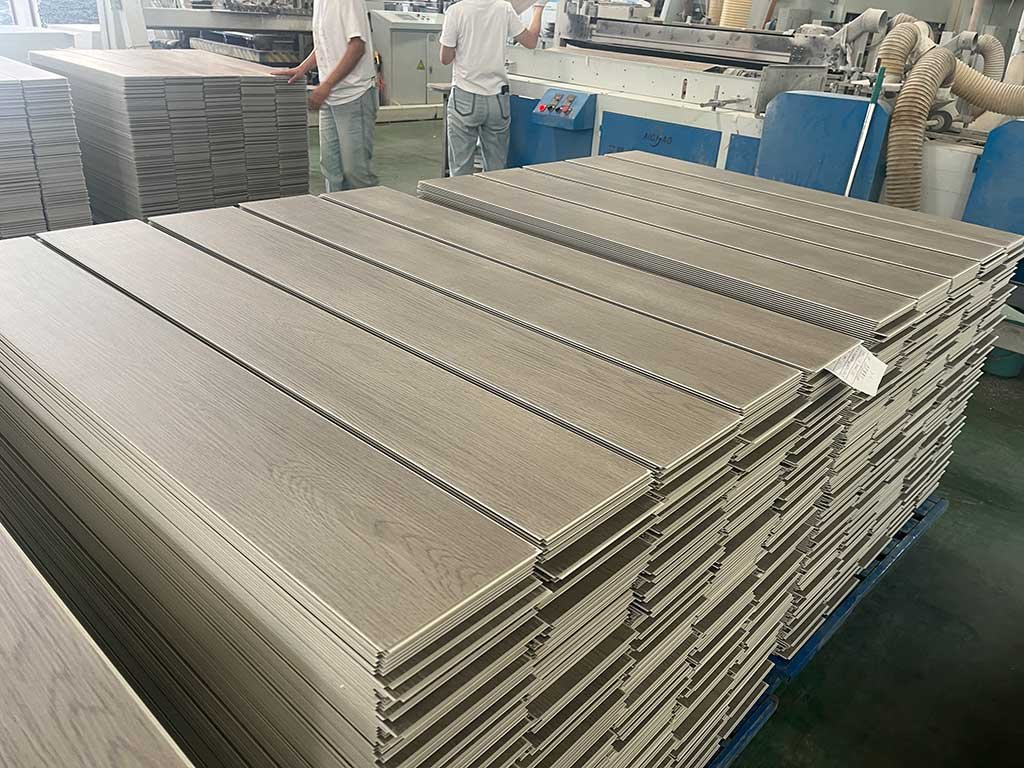
Its core is primarily made from limestone powder, PVC resin, and other additives through processes such as mixing, calendering, or extrusion. Unlike laminate flooring, which uses wood-based fiberboard as its main substrate, an SPC rigid core does not absorb water and swell in the same way as a wood-based core.
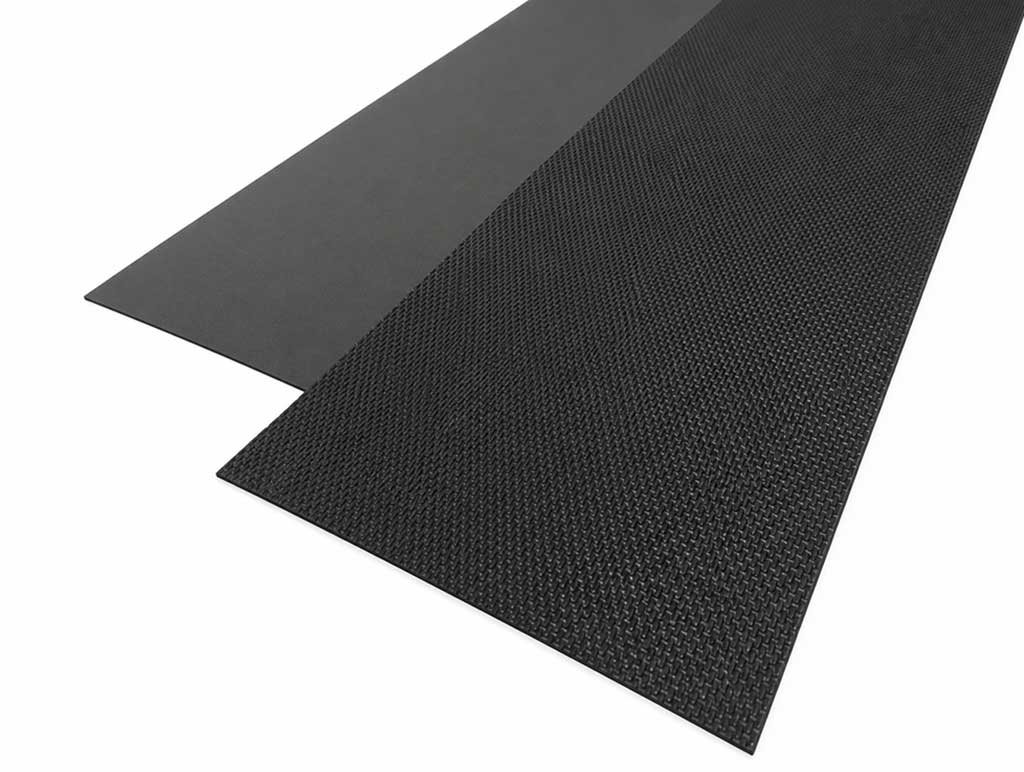
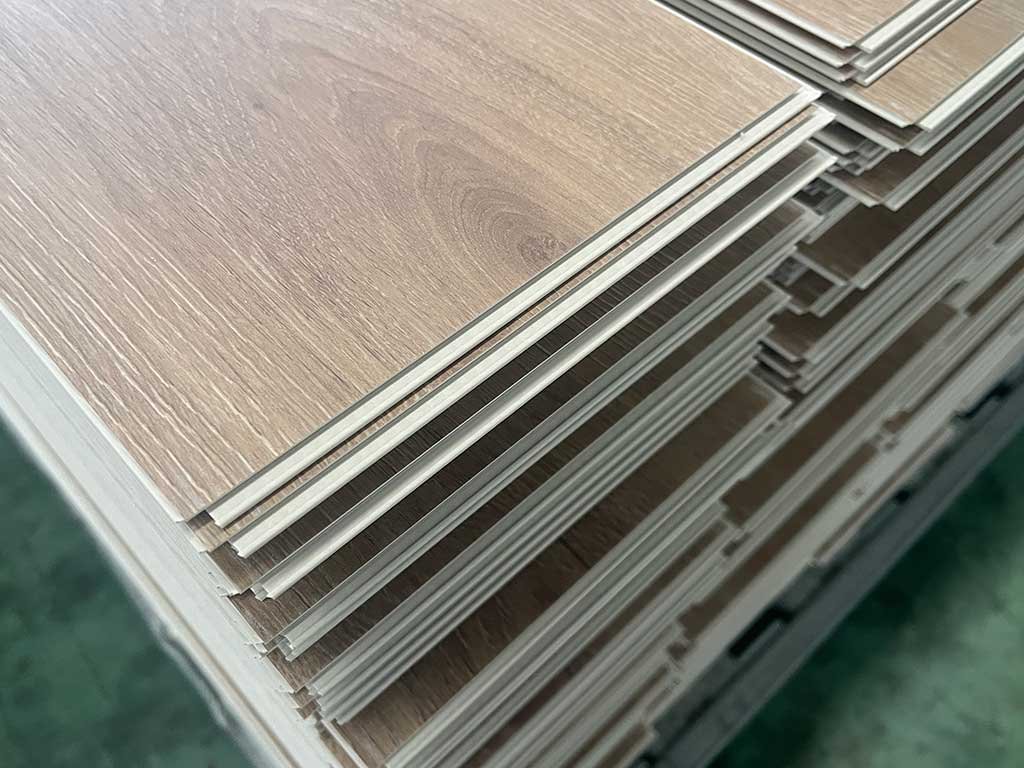
A typical SPC click-lock floor may consist of the following layers:
- UV Coating: Improves surface stain resistance, wear resistance, and UV resistance. The coating is typically around 0.01–0.03 mm thick.
- Wear Layer: Protects the decorative layer against daily foot traffic, friction, and minor scratches. Common thicknesses range from 0.10–0.50 mm.
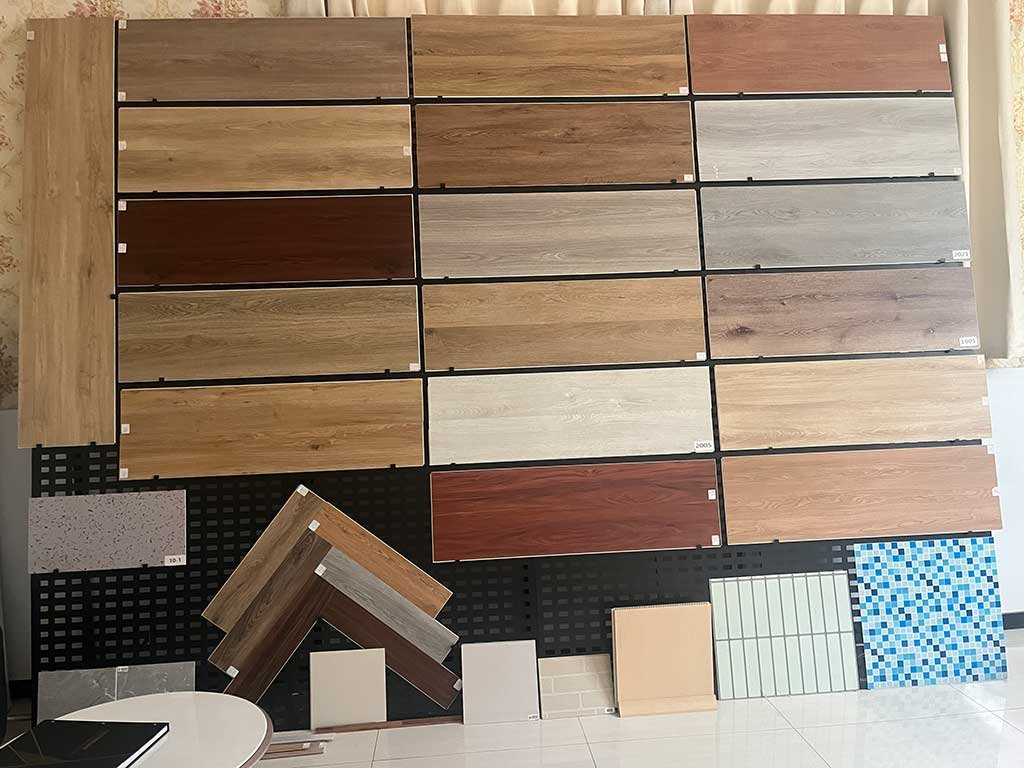
- Decorative Film: Provides the visual appearance of wood, stone, concrete, and other decorative patterns.
- SPC Core: Provides the main rigidity, dimensional stability, and structural support. The core is generally around 4–8 mm thick. The ratio of stone powder to PVC resin affects the balance between rigidity and toughness. A higher mineral filler content generally increases rigidity but can make the material more brittle, while a higher PVC resin content can improve toughness. The appropriate formulation should be determined according to the product structure and application requirements.
- IXPE or EVA Underlayment: Used to improve underfoot comfort, reduce some impact noise, and compensate for minor surface imperfections. Common thicknesses include 1 mm, 1.5 mm, and 2 mm. IXPE is generally considered to provide good resilience and sound-reduction performance.
Therefore, when evaluating an SPC floor, you should not focus only on its waterproof claim. Other important factors include core density, formulation, total thickness, wear-layer thickness, locking system, underlayment, and surface treatment.
Why Is SPC Flooring Water Resistant?
The water resistance of SPC flooring mainly comes from its rigid composite core.
Traditional laminate flooring generally uses high-density wood fiberboard as its core material. When a significant amount of water penetrates the substrate, the wood fibers can absorb moisture and swell, potentially causing buckling, deformation, or edge damage.
SPC cores are primarily made from mineral fillers and PVC-based materials rather than wood fibers. As a result, under normal conditions, the core does not absorb water and swell in the same way as wood-based flooring.
However, there is one important distinction:
Water-resistant SPC core ≠ a completely waterproof flooring system.
After installation, water may still reach the subfloor through areas such as:
- Click-lock joints between planks
- Perimeter expansion gaps
- Doorways
- Floor drains
- Pipe penetrations
- Connections between SPC flooring and other materials
Therefore, SPC is suitable for many moisture-prone environments, but it should not replace the building waterproofing system required in bathrooms, shower areas, basements, or other wet construction areas.
What Is the Difference Between SPC, WPC, and LVT Flooring?
SPC, WPC, and LVT are all widely used resilient flooring products, but their core materials and construction are different.
| Comparison | SPC Flooring | WPC Flooring | LVT Dryback Flooring |
|---|---|---|---|
| Main core material | Stone plastic composite rigid core | Wood plastic composite core | PVC-based flexible structure |
| Water resistance | Core is highly water resistant | Core is highly water resistant | PVC itself is water resistant |
| Rigidity | High | Medium | Relatively flexible |
| Underfoot feel | Firmer | Softer | Generally softer |
| Common installation | Click-lock | Click-lock | Glue-down |
| Common thickness | Approx. 4–8 mm | Approx. 6–8 mm | Approx. 2–3 mm |
| Main advantages | Dimensional stability, water resistance, durability | Softer feel and good comfort | Thin, flexible, suitable for glue-down installation |
Actual specifications vary by manufacturer, product construction, and application class, so these figures should be treated as common ranges rather than universal standards.
Where Is SPC Waterproof Flooring Suitable?
One of the major advantages of SPC flooring is its ability to provide stable flooring performance in indoor environments where resistance to moisture is important.
1. Kitchens
Kitchens are frequently exposed to water, oil, food residue, and accidental spills. SPC surfaces are generally easy to clean and can provide good resistance to everyday stains.
For kitchen applications, pay particular attention to:
- Wear-layer thickness
- Surface texture and slip resistance
- Locking-system quality
- Joint treatment
- Edge finishing around sinks and other wet areas
SPC can reduce the risk of core swelling caused by occasional spills, but significant water leaks should still be cleaned up as quickly as possible.
2. Basements
Basements are often more exposed to humidity and moisture than other areas of a building.
Because SPC does not use a conventional wood-fiber core, it can be a practical flooring option where reducing moisture-related flooring problems is important.
However, if the basement has:
- Persistent moisture or dampness
- Excessive moisture in the concrete slab
- Groundwater intrusion
- Failed damp-proofing or waterproofing
these problems should be addressed before installing SPC.
SPC flooring cannot replace basement waterproofing or moisture-control systems.
3. Bathrooms and Laundry Rooms
Some SPC products can be used in bathrooms and laundry rooms, provided that the product is approved for the intended application and installed according to the manufacturer’s requirements.
Particular attention should be paid to:
- Drainage
- Joint treatment
- Perimeter finishing
- Floor drains
- Slip resistance
- Waterproofing of the underlying structure
For areas subject to continuous standing water or direct shower exposure, SPC should not be treated as a substitute for a proper waterproofing system.
4. Commercial Spaces
Retail stores, offices, restaurants, corridors, and other commercial areas generally experience heavier foot traffic than residential rooms.
For these applications, consider:
- Wear-layer thickness
- Core thickness
- Core density
- Locking-system strength
- Scratch resistance
- Expected traffic level
For high-traffic environments, choose a product designed for commercial use rather than simply selecting the lowest-cost residential product.
How Should You Choose SPC Thickness and Wear Layer?
When purchasing SPC flooring, total thickness and wear-layer thickness are two different specifications.
For example, a product with a total thickness of 5 mm may include:
- SPC core
- Decorative film
- Wear layer
- UV coating
- IXPE or EVA underlayment
Therefore, a thicker floor does not automatically mean better wear resistance.
Total Thickness
Common SPC flooring products are generally available in thicknesses of approximately 4–8 mm.
Around 4 mm is common for many residential applications. If you want a more substantial structure, improved underfoot feel, and potentially stronger click-lock performance, 5 mm or 6 mm products may be considered.
However, thickness should never be evaluated alone. Core density, formulation, locking design, and overall construction are also important.
Wear Layer
Common wear-layer thicknesses include:
- 0.20 mm
- 0.30 mm
- 0.50 mm
- 0.70 mm
Specifications vary depending on the market and product grade.
In general, a 0.30 mm wear layer can be suitable for many residential applications, while 0.50 mm and above is often selected for applications requiring higher wear resistance, including many commercial environments.
However, wear-layer thickness alone does not determine the service life of a floor. Material composition, surface treatment, testing standards, traffic intensity, and maintenance also affect actual performance.
What Should You Consider When Installing SPC Flooring?
SPC click-lock flooring is relatively easy to install, but subfloor preparation is often more important than the actual installation process.
Step 1: Check the Product and Installation Environment
After the flooring arrives at the installation site, allow it to acclimate according to the manufacturer’s requirements.
Some products recommend 24–48 hours of acclimation before installation, but the exact temperature, humidity, and acclimation requirements should always follow the product’s technical documentation.
Keep cartons stored flat and avoid improper stacking that could deform the planks.
Step 2: Inspect the Subfloor
The subfloor should be:
- Flat
- Dry
- Clean
- Solid
- Free from significant unevenness
When installing over a concrete slab, moisture or humidity testing should be carried out according to the project requirements and flooring manufacturer’s specifications.
If the subfloor has significant moisture, hollow areas, cracks, or unevenness, these problems should be corrected before installing SPC.
Step 3: Allow for Expansion
Click-lock SPC flooring generally requires an expansion gap around walls, columns, and other fixed structures.
The exact gap should follow the manufacturer’s installation instructions. A common recommendation is approximately 8–10 mm, but requirements vary between products and installation conditions.
Step 4: Connect the Locking System Correctly
Install the planks according to the specific locking-system design.
Do not strike the flooring surface aggressively with a hammer, and do not force planks together when the locking profiles are misaligned.
Proper installation can help reduce:
- Open joints
- Broken locking profiles
- Chipped edges
- Noise during use
What Should Wholesale Buyers Check Before Purchasing SPC Flooring?
For importers, wholesalers, flooring distributors, and project contractors, purchasing SPC flooring should involve more than comparing product photos and prices.
At minimum, buyers should verify the following:
| Inspection Item | What to Check |
|---|---|
| Total thickness | Verify the actual construction thickness rather than relying only on marketing specifications |
| SPC core | Check formulation, density, and consistency |
| Wear layer | Confirm the exact specification, such as 0.20, 0.30, 0.50, or 0.70 mm |
| Decorative film | Check color, pattern, and batch consistency |
| UV coating | Confirm the surface treatment |
| Locking system | Test actual installation, disassembly, and joint stability |
| Underlayment | Confirm whether the product uses IXPE, EVA, or no attached pad |
| Dimensional stability | Request relevant test data |
| Water absorption / water resistance | Request formal test results |
| Environmental testing | Confirm standards required in the target market |
| Batch consistency | Pay particular attention to color and dimensional consistency for large orders |
Don’t Just Ask, “Is It 100% Waterproof?”
This is an important point that is often overlooked when purchasing SPC flooring.
A more useful question is:
“What is the composition of your SPC core, and what are the water absorption, dimensional stability, and relevant test results?”
The phrase “100% waterproof” is often used as a marketing description. To properly evaluate a product, buyers should examine its actual construction, technical specifications, and test results.
How Long Does SPC Flooring Last?
There is no single service-life figure that applies to every SPC product.
Actual service life depends on factors such as:
- Wear-layer thickness
- Product construction
- Frequency of use
- Foot traffic
- Installation quality
- Subfloor condition
- Furniture and equipment loads
- Maintenance
- Sunlight and temperature fluctuations
For example, a residential bedroom and a busy commercial corridor have very different usage conditions. Therefore, it is not appropriate to use a fixed figure such as “20 years” or “30 years” to describe every SPC flooring product.
For commercial or wholesale projects, it is better to review the manufacturer’s test reports, intended-use classification, warranty terms, and technical specifications.
Conclusion
For residential applications, pay particular attention to underfoot comfort, surface wear resistance, and locking-system quality.
For commercial projects, consider traffic levels, wear resistance, core construction, and long-term dimensional stability.
For kitchens, basements, bathrooms, and other moisture-prone areas, evaluate both the flooring’s water resistance and the moisture-control and waterproofing conditions of the underlying structure.
The main advantage of SPC is not that “you never have to worry about water.” Instead, when the right product is combined with proper subfloor preparation, correct installation, and suitable specifications, SPC can provide a stable, durable, and easy-to-maintain flooring solution for many moisture-prone environments.
FAQ
Is SPC Flooring Really Waterproof?
The rigid SPC core itself has excellent water resistance and does not absorb water and swell as easily as wood-based fiber cores. However, water can still enter through click-lock joints, perimeter gaps, and pipe penetrations. Therefore, SPC flooring should not be considered a complete building waterproofing system.
Can SPC Flooring Be Installed in Bathrooms?
Some SPC flooring products can be used in bathrooms, laundry rooms, and other moisture-prone areas, but installation must follow the manufacturer’s requirements. Particular attention should be paid to waterproofing and joint treatment around shower areas, floor drains, and wall corners.
Is SPC Flooring Suitable for Basements?
SPC flooring is generally well suited to basement floors where good water resistance is required. However, before installation, make sure the concrete subfloor does not have serious moisture or water seepage problems. SPC flooring cannot replace a basement moisture barrier or waterproofing system.
Does SPC Flooring Need a Moisture Barrier?
Whether an additional moisture barrier is required depends on the subfloor type, flooring construction, and the manufacturer’s installation requirements. When installing SPC flooring over a concrete subfloor, the moisture level and building moisture protection conditions should be checked first rather than relying solely on the flooring’s water resistance.