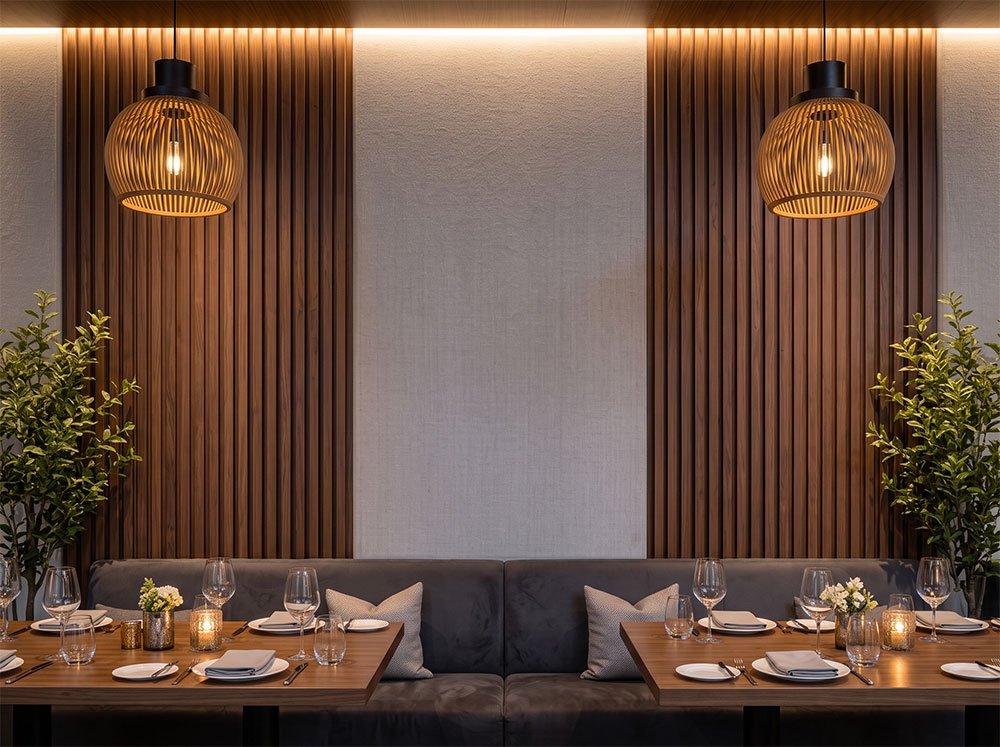
8 Key Questions About Restaurant Acoustic Design
Restaurant acoustic panels reduce noise and echo, improve speech clarity, and create a more comfortable, enjoyable dining environment.
In daily life, restaurants as public spaces are often noisy. A restaurant that offers delicious food while maintaining a comfortable acoustic environment is more likely to become a popular destination. However, restaurant acoustic design is not simply about making a restaurant quiet — it is about creating a more comfortable and enjoyable dining experience.
Table of Contents
A great restaurant should maintain a lively atmosphere with energy and personality while avoiding problems such as:
- Guests needing to speak loudly to communicate;
- Staff being constantly affected by background noise;
- Music and ambient sounds becoming unpleasant;
- Poor acoustic conditions affecting the overall interior design experience.
For interior designers, restaurant design is not only about space planning, lighting, colors, furniture, and decorative materials. It should also consider how guests experience the space through sound.
A successful restaurant should achieve:
- Visual appeal;
- Acoustic comfort;
- A memorable dining experience.
Therefore, acoustic panels for restaurants and acoustic wall solutions are becoming an important part of modern restaurant interior design.
1. Why Has Restaurant Noise Become a Business Problem?
In reality, many restaurant owners consider noise only a comfort issue. They believe that a busy and lively restaurant is naturally noisy. However, excessive noise can directly affect:
- Customer dining experience;
- Customer staying time;
- Online reviews;
- Service efficiency;
- Employee working conditions.
Modern restaurants increasingly use:
- Open kitchens;
- Large glass surfaces;
- Concrete walls;
- Stone flooring;
- Metal ceilings;
- High-density seating layouts.
These materials can create a modern, minimalist, and premium atmosphere, but they also easily reflect sound.
When sound continuously bounces between hard surfaces:
Guests raise their voices → nearby guests speak louder → the entire restaurant becomes increasingly noisy.
This creates a typical “restaurant noise cycle.”
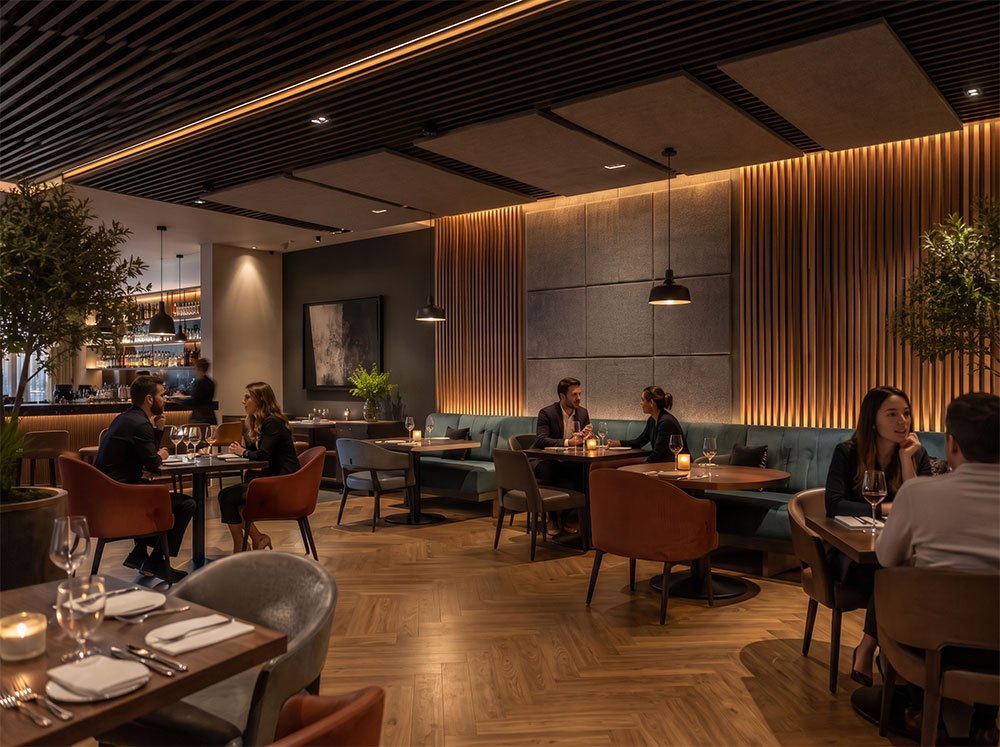
2. What Is the Goal of Restaurant Acoustic Design?
Restaurant acoustic design does not mean eliminating all sounds.
In fact, a completely silent restaurant may feel unnatural and lose the lively atmosphere that makes dining enjoyable.
The goal of effective acoustic design is to maintain the energy of the restaurant while reducing excessive sound reflections and echoes, creating clearer communication.
By using:
- Acoustic panels;
- Acoustic wall treatments;
- Acoustic ceilings;
- Soft furnishings;
- Proper space planning;
designers can improve how sound travels throughout the restaurant.
A comfortable acoustic environment helps guests:
- Hear conversations more clearly;
- Feel less tired during long meals;
- Enjoy background music more comfortably;
- Stay longer;
- Experience a higher-quality dining environment.
3. Which Restaurants Need Acoustic Panels?
Not every restaurant requires the same level of acoustic treatment. However, acoustic optimization may be necessary when the following problems appear:
1. Difficult Conversations
Guests need to move closer to hear each other or frequently ask others to repeat themselves.
2. Reduced Service Efficiency
Because of background noise, staff may:
- Mishear orders;
- Need repeated confirmation;
- Experience lower communication efficiency.
3. Noise Complaints in Customer Reviews
Common comments include:
- “The restaurant is too noisy.”
- “It is difficult to have a conversation.”
- “The background noise is too loud.”
4. Noise Becomes Uncontrolled During Peak Hours
When the restaurant becomes crowded:
- Music volume keeps increasing;
- Customers speak louder;
- The entire space feels exhausting.
5. Excessive Use of Hard Materials
Examples include:
- Glass walls;
- Tile floors;
- Concrete surfaces;
- Metal decorations.
These materials increase sound reflection.
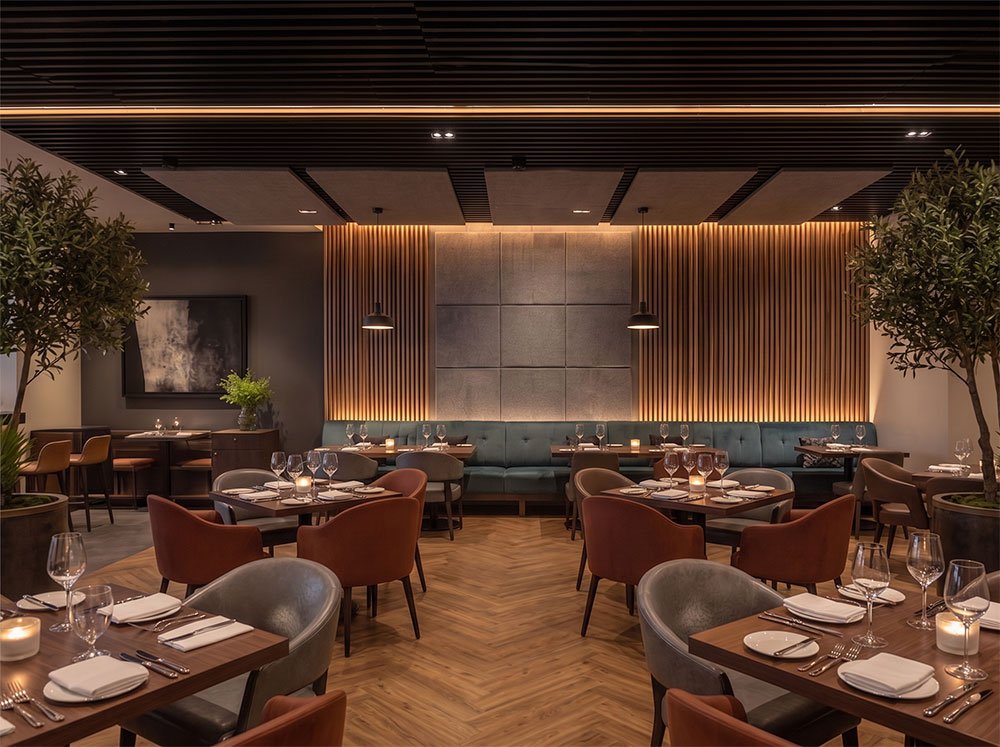
4. How Can Acoustic Panels Reduce Restaurant Noise?
For most restaurants, acoustic improvements can be achieved without a complete renovation.
Designers usually begin by treating areas with the strongest sound reflections.
1. Acoustic Wall Treatment
Large empty walls in restaurants often create sound reflections.
Installing:
- Polyester acoustic panels;
- Decorative acoustic wall panels;
- Wood acoustic panels;
can reduce reflected sound and improve conversation comfort.
2. Acoustic Ceiling Design
High ceilings and open restaurant spaces often create excessive echoes.
Solutions include:
- Acoustic ceilings;
- Acoustic baffles;
- Suspended acoustic panels.
These solutions help reduce upward sound reflections.
3. Open Kitchen Areas
Open kitchens increase interaction and visual appeal, but they also introduce:
- Equipment noise;
- Dish and tableware sounds;
- Staff conversations.
Designers can install:
- Acoustic partitions;
- Acoustic wall panels;
- Decorative acoustic materials;
between kitchen and dining areas.
4. Private Dining Areas
Private rooms require both comfort and privacy.
Proper acoustic materials can:
- Reduce sound leakage;
- Improve privacy;
- Enhance dining experiences.
5. How Can Restaurant Acoustic Panels Match Interior Design Styles?
In the past, many people believed:
“Acoustic materials will affect the beauty of a restaurant.”
However, modern acoustic products have developed from purely functional materials into important interior design elements.
Today, restaurant acoustic panels can achieve:
Customized Colors
Matching:
- Brand colors;
- Interior themes;
- Commercial design styles.
Creative Designs
Including:
- Geometric patterns;
- Wood grain finishes;
- Decorative shapes;
- Modular combinations.
Applications for Different Restaurant Styles
Cafés and Casual Dining Restaurants
Suitable for:
- Wood textures;
- Warm colors;
- Natural-style acoustic panels.
Bars and Specialty Restaurants
Suitable for:
- Dark acoustic wall panels;
- Customized designs;
- Strong visual identities.
High-End Restaurants
Suitable for:
- Minimal luxury designs;
- Hidden acoustic solutions;
- Seamless integration with interiors.
Acoustic materials are no longer only problem-solving products. They have become part of creating better spatial experiences.
6. What Is the Difference Between Acoustic Panels and Soundproofing?
This is a common misunderstanding in restaurant design.
Sound Absorption
Sound absorption mainly solves:
- Sound reflections;
- Echo problems;
- Excessive reverberation.
Examples:
- Customers’ voices becoming unclear;
- Strong echoes in the space;
- Acoustic fatigue.
Solutions include:
- Acoustic panels;
- Acoustic wall panels;
- Acoustic ceilings.
Soundproofing
Soundproofing mainly solves sound transmission from one space to another.
Examples:
- Restaurants near residential buildings;
- Hotel dining areas;
- Adjacent commercial spaces.
Solutions include:
- Soundproof walls;
- Soundproof doors;
- Structural improvements.
For most restaurants:
If the problem is “the restaurant is too noisy inside,” acoustic treatment should be considered before soundproofing construction.
7. What Should You Consider When Choosing Restaurant Acoustic Panels?
When purchasing acoustic panels for restaurants, designers should not only focus on color and price.
Important factors include:
1. Acoustic Performance
Consider:
- NRC rating;
- Material thickness;
- Density;
- Installation method.
2. Fire Performance
Commercial restaurant spaces should consider:
- Fire rating;
- Safety certifications;
- Environmental standards.
3. Cleaning and Maintenance
Restaurants should consider:
- Surface durability;
- Cleaning methods;
- Long-term performance.
4. Design Compatibility
Including:
- Colors;
- Textures;
- Sizes;
- Shapes.
The acoustic materials should match the restaurant’s brand identity.
8. Common Mistakes in Restaurant Acoustic Design
Many restaurants fail to achieve good acoustic performance not because they lack materials, but because of incorrect design approaches.
Common mistakes include:
- Installing too few acoustic panels with insufficient coverage;
- Focusing only on walls while ignoring ceilings;
- Choosing panels only based on appearance instead of acoustic performance;
- Using soundproofing solutions to solve echo problems;
- Increasing music volume to hide noise;
- Waiting until customers complain before improving acoustics.
A better approach is:
- Analyze noise sources;
- Identify sound-reflective surfaces;
- Place acoustic materials according to space functions.
Conclusion: Great Restaurant Design Should Not Only Be Seen, but Also Be Felt
Restaurant acoustic design is not about reducing the energy of a space. It is about enhancing the overall experience.
An excellent restaurant should provide:
- Attractive visual design;
- Comfortable acoustic environment;
- Clear communication experience;
- A space atmosphere that matches the brand.
By using:
- Acoustic panels for restaurants;
- Decorative acoustic wall panels;
- Acoustic wall solutions;
restaurants can effectively reduce echoes, improve restaurant noise control, and create a more comfortable dining environment.
Great restaurant design is not only about creating a beautiful space — it is about creating a complete sensory experience.
Faq:
Why do restaurants need acoustic design?
Restaurant acoustic design can reduce noise and echo, improve customers’ communication comfort, and create a better dining experience while maintaining a lively atmosphere.
What is the function of restaurant acoustic panels?
Restaurant acoustic panels absorb excessive sound, reduce sound reflection and reverberation, and help solve problems such as difficulty in conversation and noisy environments.
Where are restaurant acoustic panels suitable for installation?
Restaurant acoustic panels are commonly installed on walls, ceilings, open kitchen areas, private dining rooms, and public spaces. The specific installation location depends on the space structure and noise sources.
What is the difference between acoustic panels and soundproofing materials?
Acoustic panels mainly improve indoor echo and sound reflection, while soundproofing materials mainly prevent sound transmission to other spaces. They solve different acoustic problems.
What factors should be considered when choosing restaurant acoustic panels?
When selecting restaurant acoustic panels, factors such as sound absorption performance, fire rating, environmental protection, installation method, and whether the product matches the overall interior design style should be considered.